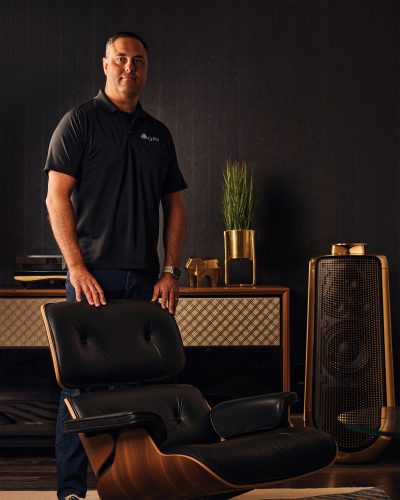
Tyson Rabani, founder and CEO of Quality Audio Video (QAV), is an alchemist, combining technology, design principles, and a never-ending quest for quality. His Centennial-based company, founded in 2006, designs and integrates residential and commercial home automation systems, with an award-winning showroom offering a preview of what’s possible in the ever-evolving realm of smart home entertainment and environment. QAV weaves together home lighting, security, environment, entertainment, and wellness systems to create what Rabani calls “a global technology ecosystem.”
Can you talk about the journey to your current role at QAV?
My journey truly started with my dad; he got me into electronics at a young age, using a turntable, surround sound, all the things that sparked my interest and joy. In high school and college, I worked for companies that kind of did what QAV does today; what I mean by that is they’re a little bit more retail store-focused, but stores like Circuit City, Car Toys, Soundtrack—these were iconic companies to be working for when you were a kid like me who was really into this stuff. Then, you’re also figuring out how to pay your bills and pay for your car and pay your way through college.

My degree in college was in mechanical engineering, and my bigger plan was to be a mechanical engineer and do this in a much larger capacity. I took a job with an oil company and ended up in remote destinations, including Casper and Rock Springs, Wyoming. I was a field engineer, which was good for my personality, but the downside was it was very clear that they wanted us working 90-plus hours a week.
I got to thinking about trying to build something on my own, and even though I wasn’t 100 percent sure what I was going to do, it led me eventually to found QAV, and so that’s the idea that sparked it–okay, 95 hours a week, maybe I should just put that time into building something on my own.
How should a homeowner start to create a smart home?
There are two different parts of their journey: the physical, meaning are they remodeling, is it new construction, is it a retrofit, meaning, ‘Hey my house is already built, I love it, I just want to make it a little bit better.’ Then there’s the other part, which is that there’s always one thing that they’re interested in that gets them to think about what QAV does.
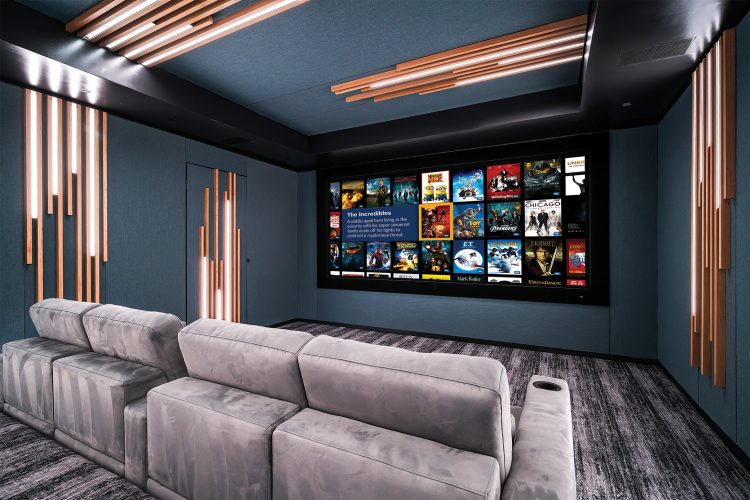
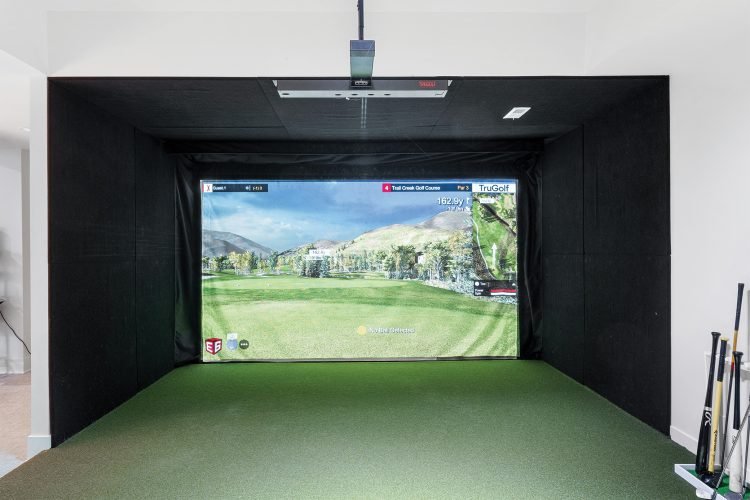
For a lot of clients, that could be lighting and shades, but another client might say, ‘No, it’s a golf simulator or multi-sport simulator.’ We just talked about two totally different clients; you also still have the movie buff who wants a theater, you have people that are concertgoers, and they want to bring the concert home. My point is everybody’s on a different spot on their journey. At the end of the day, there’s something that they’re starting to journey on, that’s bringing them incrementally.
No matter what, we start with infrastructure— do we have to retrofit, are all the wires there? — starting the journey from the planning stage. The message is that no matter where you are, understand that this is the thing that you can bring into that design process, and it will make all of the difference in the world.
The biggest thing that we struggle with is that people wait too long. We have technology designers on staff to be a part of the process; they coordinate with all of the design-build trades, architects, realtors, builders, interior designers, and we should all be working very closely.
How has the industry changed since you began?
Things either become smaller or more hidden. A giant 12- or 15-inch subwoofer that still performs very well, it’s still there, it sounds better than ever, but it’s usually hidden. TVs are also bigger than they’ve ever been: an 85-inch TV is the new 55. We’re building LED walls, where people are putting wallpaper and they’re rendering in fireplaces and they’re drawing in the TV; it becomes like an architectural scene.
Materials have evolved into beautiful finishes, with less plastics, more metals, more woods, natural earth, and stone materials that are being fully integrated into lighting, keypads, and trims, and all kinds of things. It’s all design-focused, but it is fully integrated into the whole building.
Any favorite projects?
If you look at what makes projects the most memorable and the most exciting, it’s the ones where we were working the closest with the builder, the architect, the interior designer. That is the best version of a design team that any client could ever hope for.
Other comments?
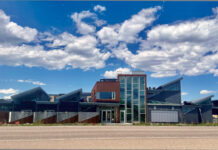
Some of the things that make QAV unique is that we have an extraordinary showroom. It was named one of the top showrooms globally. It’s in Centennial, five minutes from the Broncos training facility. That’s important because the showroom is where people can experience what’s possible. Also, everything we do is in-house. Client care, design, engineering—we control the level of quality and the output that our clients are getting.
For print-exclusive stories, download the digital magazine or pick up a copy from select local King Soopers, Safeway, Tattered Cover, or Barnes & Noble locations.