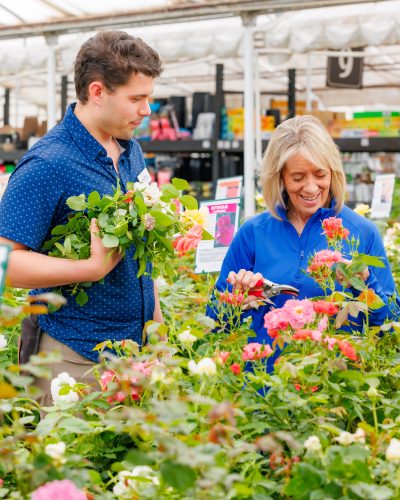
Luan Akin is the garden ambassador, and Richard Newbold supervises the Perennial/Rose Department at Tagawa Gardens, a family-owned business that has been serving Colorado gardeners since 1982. In addition to offering nearly 5,000 plants, Tagawa Gardens provides garden coaching to help customers choose the perfect perennials, trees, and shrubs for their space.
What are the biggest trends you’re seeing this summer? Richard: Colorado natives are really hitting it hard. A few years ago, it was a fad; it was cool to plant natives. We’ve passed that point, and they’re still holding on. Secondly, it’s xeric planting, especially being here in the high-altitude desert.
What do gardeners need to know about natives? Luan: People need to understand that natives are not drought-tolerant. They’re going to need two seasons of regular watering, more or less, to get that root zone established. And then you can start to cut back and consider them to be xeric. But they are not xeric from the get-go. You have to take care of it as a normal plant for the first couple of seasons and get that root system deep to where it’s protected from the heat and the drought.
What advice do you have for someone who’s transitioning their yard to low-water plantings? Richard: For someone who is transitioning from maybe a bluegrass yard to something that is more of a xeriscape or native low-water type planting, it’s kind of like, okay, have we ripped out the grass yet? We can do a nuclear option where we kill the grass with a bunch of chemicals or, if you’re willing to wait, we can do something that’s much better for the environment. We can create a compost layer from all the grass that you have right now by laying down wet cardboard and then mulch on top of that, and creating compost that can then be intermixed into your soil. We’ll need that compost eventually whenever we’re going to plant, because compost is really your big clay buster. Grass is really heavy on taking up a lot of nitrogen, so we’re adding some of that nitrogen back into the soil, and your plants are going to benefit from that.
Luan: Anybody who is making a major change in their landscape like that, I would spend the money and the time to get at least a blueprint from a licensed—repeat, licensed—landscape designer.
What makes a plant truly xeric? Richard: The big nomenclature that gets thrown around is xeric and drought-tolerant. What that means is this plant will survive—and the keyword is survive— just off of any water that falls out of the sky. That also means that if we’re never watering, our years change up pretty drastically. In some years, it’ll get overwatered, and some years it’ll get underwatered. We’ll still have to supplement a little bit.

For people just starting their gardens now, is it too late? Richard: Really, the second-best season of planting is fall and late summer. It’s getting these plants in the ground past the summer season, past when they would have done their blooming and looked extravagant, but getting them into the ground and really starting and hardening off and getting a good root system while not really expecting them to be a showy plant.
What perennials really shine in midsummer in Colorado when other plants are fading? Richard: There’s nothing like a rose. Only rose bushes are really going to provide you with that all-season interest and look extravagant throughout the entire season. Only a handful of perennials are going to do that—things like lavender that’ll look great throughout the season even though it’s only blooming during a specific time of the year. The bush looks really nice throughout the season and provides nice textures that are not just a straight green and so keep things interesting. Yarrow also has great texture and is great through midsummer. And both of those are very xeric plants. For all-season color and blooming, Jupiter’s beard is always a phenomenal hit. It is a little bit of a larger plant, anywhere from 2 to 3 feet tall and wide, but it is continually blooming and, again, xeric.
Luan: Ornamental grasses have finally caught on. Fifteen years ago, everybody wanted something that produced a flower, and I get it. But so many have become more sophisticated and understand that ornamental grasses add texture. They add winter interest. They’re just a real key component.
What are your top tips for keeping gardens thriving through Colorado’s hot, dry summer months? Luan: Water deeply until you know that the water is getting down to wherever the bottom of that root system is, and that will change a bit over the course of the summer and the season. But make sure they’re getting deep, deep drinks. And when that hot weather comes, with a little bit of the help from some mulch, those plants are going to do a whole lot better than plants that are getting real shallow watering where the roots don’t especially have any incentive to go deeper.
What is your favorite plant to grow in summer? Luan: My all-time favorite vegetable, if I could grow, nothing else, would be a Sun Gold tomato. It’s a vining tomato, so it will keep producing all season as long as it’s healthy. It’s a good-sized cherry tomato, and when I go out to pick mine, about half of them make it into the house. They’re so, so good—not too sweet, not too tart. Then one of my go-to perennials would be salvia called Rose Marvel. It’s a fuchsia, but it’s not electric. It’s just a lovely, lovely color.
Richard: My personal favorite plant has to be, hands down, rose bushes. There’s nothing like a rose bush. That’s the reason why they’ve been in society for hundreds of thousands of years. And why there’s plays written on about them. I have at least eight rose bushes in my postage stamp of a yard.