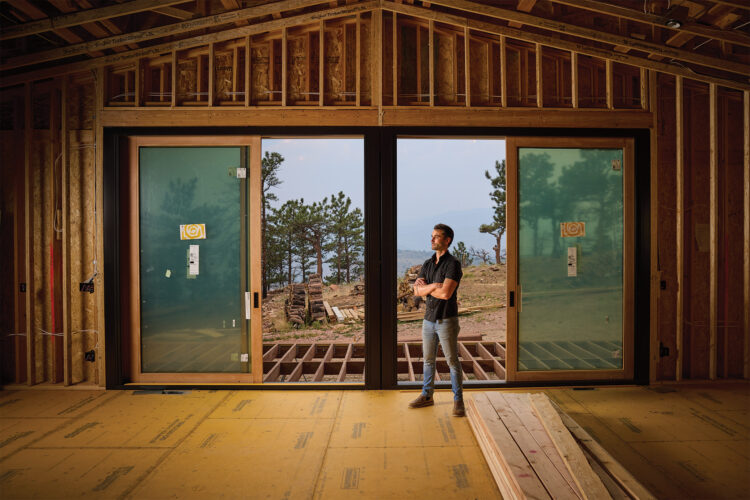
Alex Molkentin’s appreciation for craftsmanship and love for building come naturally. He grew up watching his father and grandfather build meticulously detailed custom homes in Ohio before moving to New Zealand, where his passion for creating beautiful things was honed.
Molkentin’s Lyons-based firm, Fernhill Construction, specializes in custom home builds, high-end remodels, and construction consulting along the Front Range. Through his podcast, The Build Project, he explores residential construction through conversations with architects, builders, and makers of all kinds.
You grew up watching your father and grandfather build extraordinary homes. What lessons from them have become non-negotiable in your own company?
I think the biggest lesson, looking back, is actually how to treat people. That not only includes your clients and the design professionals at the beginning phase of a project, but also every person who has a hand in making that home something special. The way you treat those people, you feel it at the end of a project. It can be something as small as a cooler with cold drinks on a hot day, but it can also just be showing genuine interest in making sure that everyone’s happy and living a full, good life as a result of being a part of it.
You often say business is solving people’s problems. Can you talk about how that mindset affects the way you work with clients?
I think asking people to identify what problem it is that they need me to solve is a really, really powerful tool. It sounds simple. Just build me a beautiful home. Well, with an infinite budget and an infinite amount of time, that’s one set of problems. But in the real world, there’s another set of problems that is different for every single client. Some of my clients, the problem they want me to solve is that they want to feel craft. I approach that problem differently than when somebody says, “We want a nice home, but we also need it within X amount of time, and we do have a firm budget.” Both are going to be beautiful, well-built spaces, but they’re two very different things. And having people understand that that requires two different approaches helps them feel empowered in the process.
You pay trade partners to participate in pre-construction. How did you come to that practice and how does it benefit the project?
I want people who are willing to be held accountable and willing to stand behind the insights they’re giving us. In order for that to be the case, people need to be and should be compensated for that. If anyone’s gone through the process of building a custom home, you know it’s a lengthy journey. It’s a roller coaster ride. You want it to be a fun ride, but it’s a ride nonetheless. If you know there was intention and context and a true level of expertise invested at every single step, that does feel different. I think my clients, knowing the amount of effort and thought that goes into those things, it makes them proud too.
How do Colorado’s climate and lifestyle influence the way you think about materials, durability, and longevity?
The ethos of Colorado is to be energy aware, fire resistant, and long-term sustainable. So, that impacts the types of materials we use. It means we need to be putting in due diligence and really contextualizing the overall package of selections we’re making so it’s in alignment with the Colorado proposition.
What trends are you seeing in Colorado homes that you think have staying power?
I think the trends that are going to stay are going to be the environmental efficiencies, the long-term sustainability. Air tightness is a conversation mostly in the energy realm, but a lot of the data that came out as a result of the Palisades Fire show that one of the greatest ways you can be fire resistant is to actually be airtight. Being insurable, being safe, protecting your investment—those are all things that should be a part of everyone’s conversation.
What innovations, technological or cultural, will have the biggest impact on luxury home building over the next decade?
Two things. We’re very AI-centric. I was part of a panel talking about AI being involved in construction, and my favorite line is that AI will never build your house. And I took that analogy further to say, AI will never swing a hammer, but it will make sure that we are using the absolute most efficient hammer on the market and swing it in the most efficient way possible, therefore hopefully bringing more value to the process of actually swinging a hammer, aka building your house. It’s also going to make the relationship between small companies and clients more professional. It allows me to have access to really robust contracts and communication management styles. I think that’s a big one.
The other one is panelization, which is already very big in Europe. Panelization basically allows us to leverage manufacturing settings in low-cost labor areas and then have shorter-term building seasons, like say in the ski towns. So, we can build a home at a very, very high standard in a short period of time.
What one piece of advice do you have for people who are building a home?
Get to know somebody on the job site that might not be the owner of the company. And just recognize that there are incredible people who are a part of building these incredible spaces. And my promise to you is that once you learn how incredible those people are, your home is going to feel a little different.
For print-exclusive stories, download the digital magazine or pick up a copy from select local King Soopers, Safeway, Tattered Cover, or Barnes & Noble locations.